“Any family history of heart disease?”
It’s one of the first questions every new doctor asks — and the moment many of us realize we don’t actually know. What did grandpa die of, exactly? Was aunt Maria’s illness cancer or something else? You answer “I don’t think so?” and the appointment moves on, with a blank where useful information should be.
I build a tool that helps people organize their medical history for doctors, and family history is the one part no app can dig out of your documents — it lives in your relatives’ memories. This page gives you a free template to capture it, and a short guide on what to record, how far back to go, and how to actually get answers from your family.
Download the Free Family Medical History Template (PDF + Google Doc)
Two formats, no email required:
Download PDF Editable version (.docx)- PDF — print it and fill it in by hand, or bring it to a family gathering.
- Editable (.docx) — open it in Google Docs or Microsoft Word and keep it updated over time. For Google Docs: upload the file to Google Drive and open it — it converts automatically.
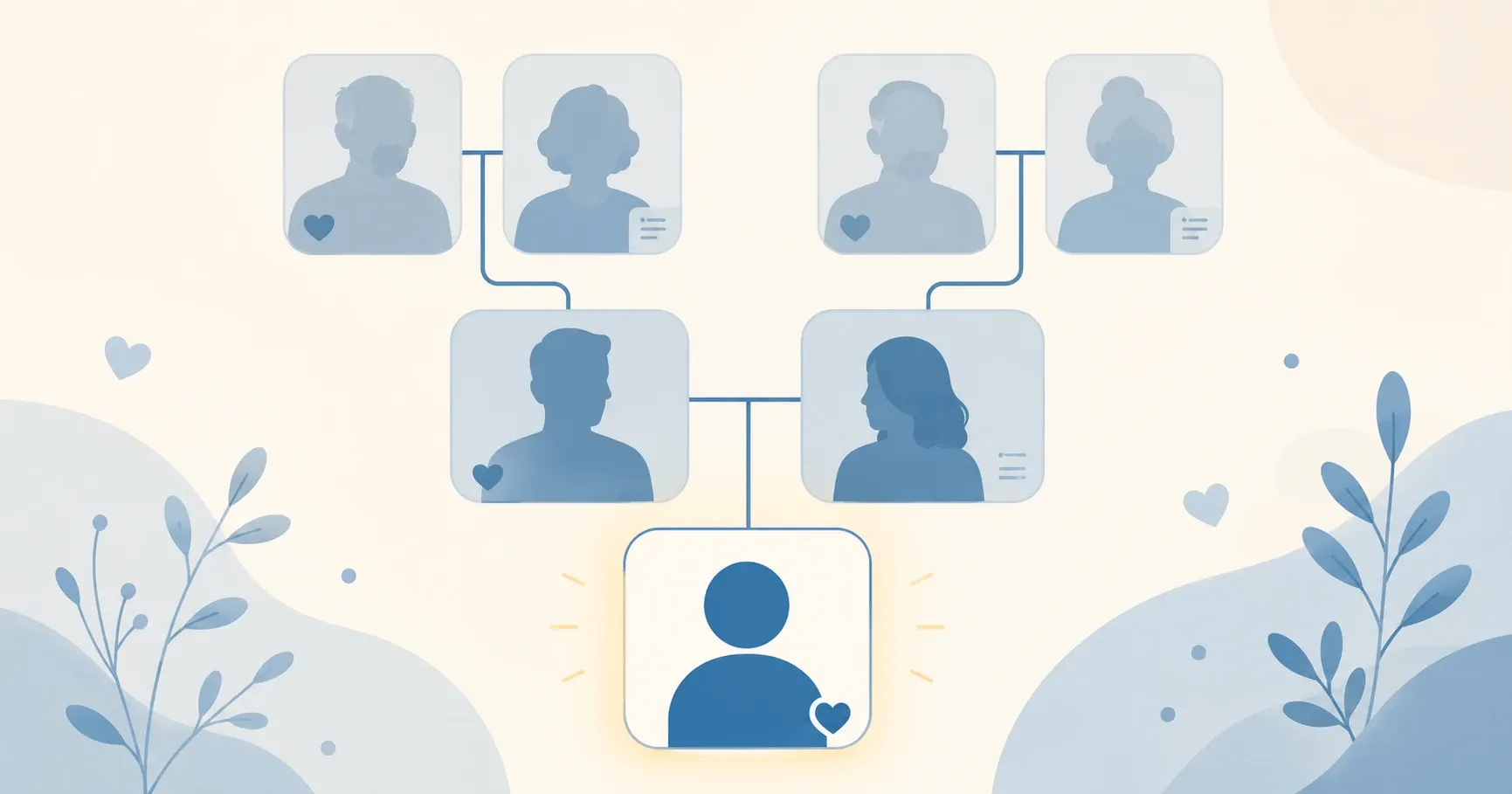
The template covers three generations on a single spread: your immediate family first (parents, siblings, children), then your mother’s side, then your father’s side. For each relative there’s space for their conditions, the age those conditions started, and whether they’re living or deceased.
If what you’re looking for is a template for your own history — conditions, medications, surgeries — that’s a different document: grab our general medical history template instead. This one is specifically about your relatives.
Why Doctors Ask About Your Family History
Family history is one of the few things about your health that no test can replace. Many conditions — heart disease, type 2 diabetes, certain cancers, high blood pressure — run in families, through some mix of genes and shared habits.
Doctors use this information in a practical way: it helps them decide what to watch for and when to start. A family history of colorectal cancer at 50 may mean your doctor suggests screening earlier than the standard age. A parent with early heart disease may change how seriously your cholesterol numbers get treated. The history doesn’t predict anything by itself — it helps your doctor calibrate attention.
Which is why a half-remembered “I think someone had something” is worth upgrading to a page of actual answers.
Which Conditions to Track (and Why Age of Onset Matters)
You don’t need to record every cold your relatives ever had. The conditions worth writing down:
- Heart disease and stroke — heart attacks, bypass surgery, stents, strokes.
- High blood pressure and high cholesterol — especially if diagnosed young.
- Diabetes — type 1 and type 2.
- Cancer — with the type and, if known, the age at diagnosis. Breast, ovarian, colorectal, and prostate cancer are the ones where family history changes screening most.
- Mental health conditions — depression, bipolar disorder, schizophrenia, substance use. Often left off family histories, and often the most useful to include.
- Autoimmune and thyroid conditions — rheumatoid arthritis, lupus, thyroid disease.
- Anything unusual or early — a relative who needed dialysis at 40, lost vision young, or died suddenly before 50.
The single most valuable detail is age of onset. “Grandfather had a heart attack” means one thing at 85 and something quite different at 48. If you learn only one fact per relative, make it what and when.
How Far Back to Go: Three Generations
The standard answer — and what most doctors will actually use — is three generations:
- First degree: parents, siblings, children. These matter most; you share the most genes with them.
- Second degree: grandparents, aunts, uncles, half-siblings. Especially useful for spotting patterns — two aunts with the same cancer is a signal.
- That’s usually enough. Great-great-grandparents are genealogy, not medicine.
Note the direction of the question: it’s not “how far back in time” but “how close the relative.” A sibling’s diagnosis last year matters more than anything from 1950.
How to Ask Your Relatives
The template is the easy part. Getting the information usually means conversations — and a few things make them go better:
Lead with the reason. “My doctor asked about our family health history and I realized I don’t know it” is a disarming opener. You’re not prying — a doctor asked.
Ask about people, not diseases. “What do you remember about grandma’s health?” opens more doors than a checklist. Follow up on specifics afterwards.
Use family gatherings. One conversation where three relatives correct each other’s memories is worth five separate phone calls. Holidays genuinely are the best data-collection events available.
Start with the family historian. Most families have one person who remembers everything — often an aunt or a grandmother. Start there, verify elsewhere.
Accept incomplete answers. “Something with her stomach, she was maybe 60” is a real data point. Write it down as-is, with a question mark. Doctors work with uncertainty all day.
Some of these conversations touch grief — you’re asking how people got sick and died. Go gently, and don’t push past what a relative wants to share.
Filling Out the Template
Work through it in this order:
- Yourself and your immediate family first — you know the most, and it matters the most.
- One side at a time — finish your mother’s side before starting your father’s. Mixing sides is how details get attached to the wrong grandparent.
- One line per relative — condition(s), age of onset, living or deceased. For deceased relatives, add age and cause of death if known.
- Mark the unknowns — a “?” is information too. It tells you who to ask about next time.
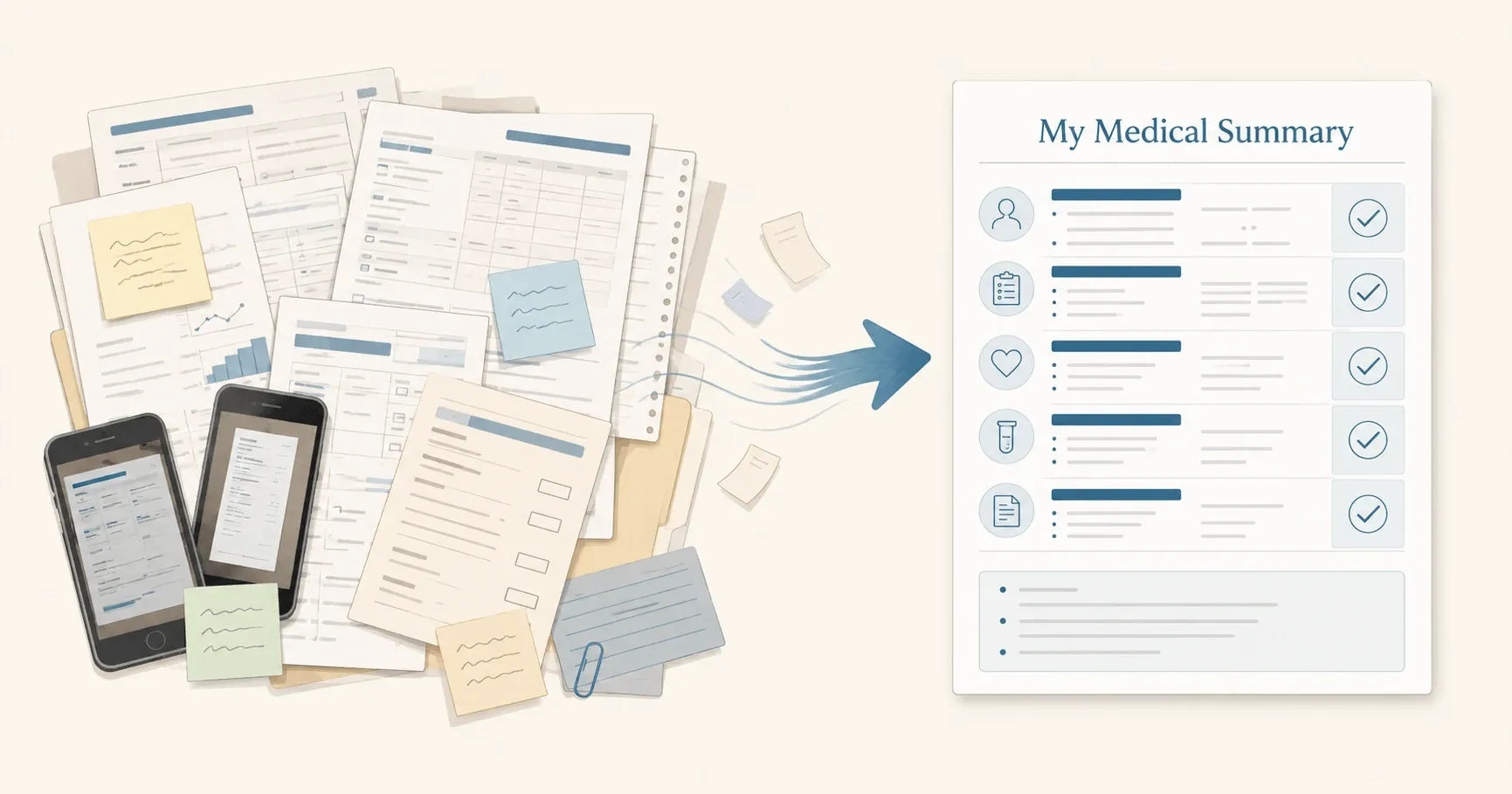
Once it’s filled in, your family history becomes one section of the bigger document your doctor actually needs — your own medical history. That’s what MyMedica helps with: upload your medical documents, add your family history once, and it keeps everything assembled as a one-page summary for every new doctor.
What If You Can’t Get Your Family History?
Not everyone can. Adoption, estranged families, relatives lost to war or migration, records in another country, or simply no one left to ask — for many people, most of the tree is blank, and no amount of asking will fill it.
Two things worth knowing:
“Unknown” is a valid answer. Tell your doctor your family history is unavailable and why. That’s not a failed answer — it’s information they’ll factor in, and in some cases it may shift decisions toward standard screening schedules or, rarely, genetic testing. That conversation is theirs to have with you.
Your own history becomes more valuable. When the family layer is missing, a complete, well-organized record of your health carries more weight. Start with our personal medical history template, or read our guide on how to summarize your medical history for a new doctor.
Frequently Asked Questions
How far back should a family medical history go?
Three generations: parents, siblings, and children first, then grandparents, aunts, and uncles. Closer relatives matter more than distant ancestors.
Do half-siblings count?
Yes — they share one parent with you, which makes them second-degree relatives, about as informative as grandparents. Note which parent you share.
I'm adopted and don't know my biological family's history. What should I do?
Record what you know, even if it’s nothing, and tell your doctor your biological family history is unavailable. If any medical information was shared at adoption, include it. See the section above — an unknown history is something doctors know how to work with.
What's the difference between a family medical history and a personal medical history?
The family version records your relatives’ conditions to help assess inherited risk. The personal version records your diagnoses, medications, allergies, and surgeries. Doctors want both; they’re separate documents. The personal one is here: free medical history template.
Should I include lifestyle-related conditions, like a relative who smoked and got lung cancer?
Yes, and note the context (“smoker for 40 years”). Doctors are good at separating inherited risk from lifestyle — give them the facts and let them interpret.
Ask while you can
The honest reason to fill this template out sooner rather than later: family history has a deadline. The people who remember it won’t always be here to ask. One afternoon of conversations can give your doctors — and someday your children’s doctors — information nothing else can replace.
Download the template, take it to the next family dinner, and file the result with your own records. And when you’re ready to put your whole history on one page for your doctor, MyMedica assembles it for you — upload your documents, add the family section once, and every new appointment starts with the full picture.
This article is for informational purposes only and isn’t medical advice. A family history helps your doctor see patterns and decide what to watch — interpreting it is their job, in person.