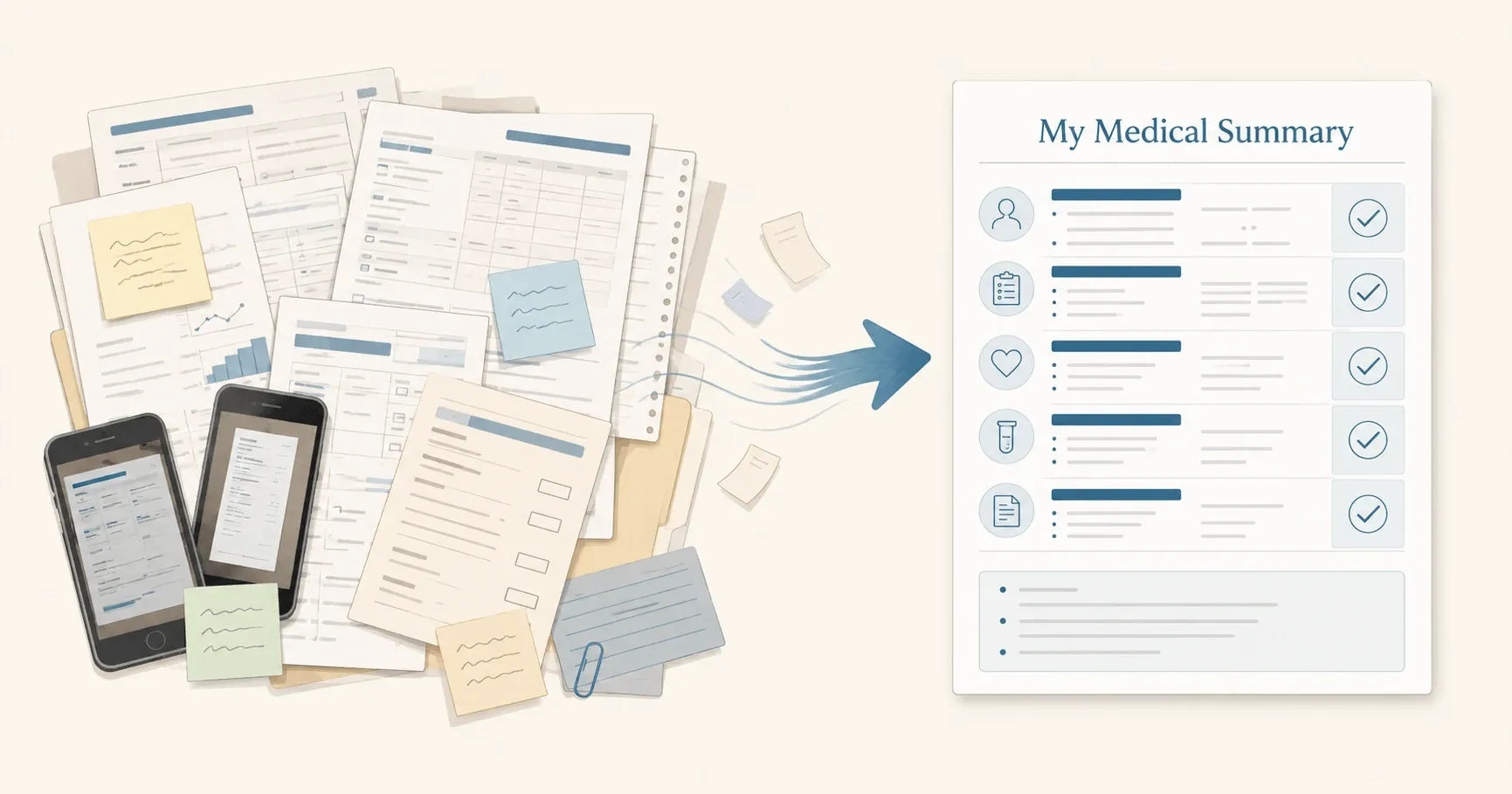
If you’ve ever sat in a new doctor’s office scrolling through your phone, hunting for a photo of a lab result from two years ago while the doctor waits — this page is for you.
I built a product that turns scattered medical documents into a one-page summary for doctors, and before that, I was the patient doing the scrolling. Along the way I’ve asked a lot of physicians one question: what do you actually need from a patient’s history? Their answers shaped the free template below — and this guide on how to fill it out so your next appointment starts with answers instead of archaeology.
No email required. Download it, fill it out, bring it to your next visit.
Download the Free Medical History Template (PDF + Google Doc)
The template comes in two formats:
Download PDF Editable version (.docx)- PDF — print it and fill it out by hand.
- Editable (.docx) — open it in Google Docs or Microsoft Word, type your answers, and update it over time. To use it in Google Docs: upload the file to Google Drive, open it, and it converts automatically.
It has two parts, and the order matters:
- Page 1 — a one-page summary. Your active conditions, current medications, allergies, and recent procedures. This is the page your doctor will actually read.
- Pages 2–4 — the full history. Past illnesses, surgeries, family history, lifestyle, and immunizations. This is the reference your doctor will skim or keep on file.
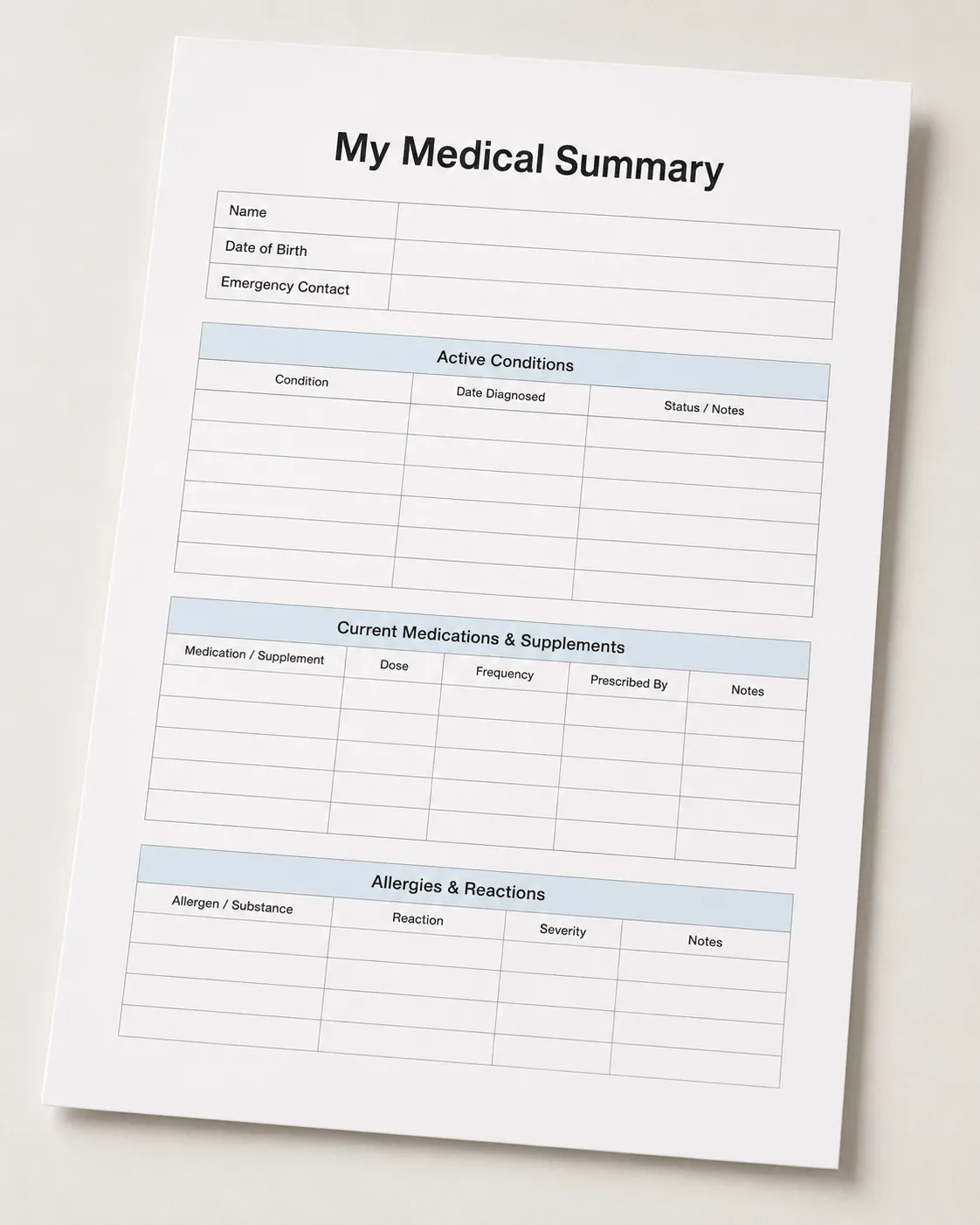
Most medical history form templates you’ll find online are built for clinics — intake paperwork designed to be filed, not read. This one is built for you, the patient, to make sure the important things get seen. (That said, if you run a small practice, it works fine as a new patient intake form too.)
What Doctors Actually Want to See in the First 30 Seconds
A typical primary care appointment in the US lasts about 15–20 minutes. If ten of those minutes go to reconstructing your history, that time comes out of the part where the doctor actually helps you.
When physicians open a patient’s history, here’s what they look for first:
Current medications, with doses. Not “a blood pressure pill” — the name, the dose, and how often you take it. This single item prevents dangerous drug interactions and is the first thing checked before any new prescription.
Allergies and bad reactions. Especially drug allergies, and what actually happened: a rash and anaphylaxis are very different signals.
Active conditions. What you’re currently diagnosed with and being treated for — not your entire life story, just what’s true today.
Recent surgeries and hospitalizations. Roughly the last five years, with dates. Older events matter, but they belong in the full history, not the summary.
A short timeline of the current problem. If you’re coming in about something specific: when it started, what’s been tried, what changed.
That’s it. That’s the first 30 seconds. Everything else — childhood illnesses, family history, the specialist you saw in 2019 — matters, but it’s reference material, not the headline. This is exactly why the template puts a one-page summary up front: doctors read top-down, and the top should carry the most important facts.
How to Fill Out Your Medical History Form, Section by Section
Set aside a quiet evening for the first pass. It’s the hardest part — after that, you’ll only be updating.
Personal information
Full name, date of birth, emergency contact, and your primary doctor’s name and phone number. Skip anything that doesn’t help a physician treat you — this is your document, not an insurance form.
Current conditions
List every condition you’re currently diagnosed with or being treated for, with the approximate date of diagnosis. If something is suspected but not confirmed, write it that way — “under investigation since March 2026” is useful information, not a confession.
Medications and supplements
Every prescription drug with name, dose, and frequency — plus over-the-counter medications, vitamins, and supplements you take regularly. Doctors need the full picture: supplements interact with prescriptions more often than people expect.
Allergies and reactions
Drug allergies first, then food and environmental ones. For each, note what the reaction was and how severe. “Penicillin — rash” and “penicillin — anaphylaxis” lead to very different decisions.
Past medical and surgical history
Major illnesses, surgeries, and hospitalizations, each with an approximate date (the year is enough) and any complications. Go as far back as you can, but don’t stress about precision — “appendectomy, around 2008” beats a blank field.
Family history
Conditions in your parents, siblings, and grandparents: heart disease, cancer, diabetes, stroke, mental health conditions. Add the age of onset if you know it — early onset in a close relative changes how doctors assess your risk.
Lifestyle
Smoking, alcohol, exercise, and anything else that affects your health. Be honest — this section is for your care, not for judgment, and doctors have heard it all.
Immunizations
Vaccines and dates, as best you can reconstruct them. Your last tetanus shot is the one you’ll be asked about most often.
Using This Template as a New Patient
A completed template is most valuable at a first appointment, where the doctor knows nothing about you. Alongside the filled-out form, bring:
- Recent test results — labs and imaging from the last year or two.
- Names and locations of your previous doctors, so records can be requested if needed.
- A list of your questions, written down. Appointments go fast, and it’s easy to forget the thing you actually came for.
Many clinics will hand you their own new patient medical history form in the waiting room. Filling it out takes two minutes when you’re copying from your own template instead of reconstructing your life from memory in a plastic chair.
Keeping Your Health History Form Up to Date
A health history form is only as good as its last update. Three habits keep it useful:
- Update it after every significant event — a new diagnosis, a new medication, a procedure. Two minutes while it’s fresh.
- Do a quick review twice a year. Remove medications you’ve stopped, close out resolved conditions.
- Keep it findable. A printed copy in a folder at home, and a digital copy you can pull up on your phone in any waiting room.
Frequently Asked Questions
What should be included in a medical history template?
The core sections are: personal and emergency contact information, current conditions, medications and supplements (with doses), allergies and reactions, past illnesses and surgeries, family medical history, lifestyle factors, and immunizations. The template on this page covers all of them, with a one-page summary up front.
How do I write my own medical history?
Start with what’s true today: current diagnoses, medications, allergies. Then work backwards — surgeries and hospitalizations with approximate years, then family history. Keep it chronological and factual, and don’t worry about medical terminology; plain language you’re sure about beats jargon you’re guessing at.
How far back should my medical history go?
For the summary page: the last five years, plus anything ongoing. For the full history: as far back as you can reasonably reconstruct. Childhood conditions matter if they’re chronic or surgical; a flu in 2012 doesn’t.
What's the difference between a medical history form and a health history form?
In practice, nothing — the terms are used interchangeably. “Patient medical history template” and “personal medical history template” also describe the same document; the first is language clinics use, the second is language patients use. This template works for both.
Should I bring a printed copy or a digital one?
Both, ideally. Print is fastest to hand over at the front desk; a digital copy means you’re never caught without it.
One page, thirty seconds
I made this template because I’ve been the patient with the 40-screenshot camera roll, retelling the same story to every new specialist. A one-page history changes the feel of an appointment: the doctor starts by understanding you, not by interviewing you.
Fill out the template — it’s a genuinely good evening’s investment. And if your history lives in a pile of PDFs, scans, and phone photos, MyMedica can do the assembling for you: upload your documents, and it turns them into a clean one-page summary your doctor can read in thirty seconds.
This article is for informational purposes only and isn’t medical advice. A medical history document helps your doctor see your story — diagnosis and treatment are always their job, in person.